Slide 1 of 7

Guardrail Strategies

Advanced techniques for ensuring agent safety and reliability

AI Agent Bootcamp

Logo Lonely Octopus

Press space or right arrow to begin
AI Agent Bootcamp
Guardrail Strategies

1. Introduction to Advanced Guardrails

As AI agents become more powerful, implementing robust guardrails becomes increasingly critical for safe, reliable, and trustworthy operation.

Why Advanced Guardrails Matter

  • Basic guardrails are necessary but insufficient for complex agent systems
  • Advanced agents require multi-layered protection mechanisms
  • Guardrails protect both users and your organization from unintended consequences
  • Different use cases and domains require specialized guardrail strategies

Key Objectives

  • Ensure agent behavior aligns with intended use cases
  • Prevent harmful, illegal, or unethical actions
  • Maintain data privacy and information security
  • Create graceful failure modes when unexpected situations arise
  • Establish monitoring and intervention protocols
"Advanced guardrails don't just prevent negative outcomes, they actively guide your agent toward more helpful, accurate, and reliable behavior in complex real-world scenarios."
AI Agent Bootcamp
Guardrail Strategies

2. Defense in Depth Approach

A layered defense strategy ensures that if one safeguard fails, others remain in place to prevent harm.

The Five Layers of Agent Safety

Input Validation

Sanitizing and filtering user inputs before processing

System Instructions

Robust prompting with clear behavioral boundaries

Content Moderation

Automated screening of all in/out communications

Tool Permissions

Careful control over available actions and resources

Monitoring System

Continuous oversight and intervention capabilities

"No single safeguard is foolproof. The most resilient agent systems implement guardrails at every level, from input to output, with special attention to how these layers work together."
AI Agent Bootcamp
Guardrail Strategies

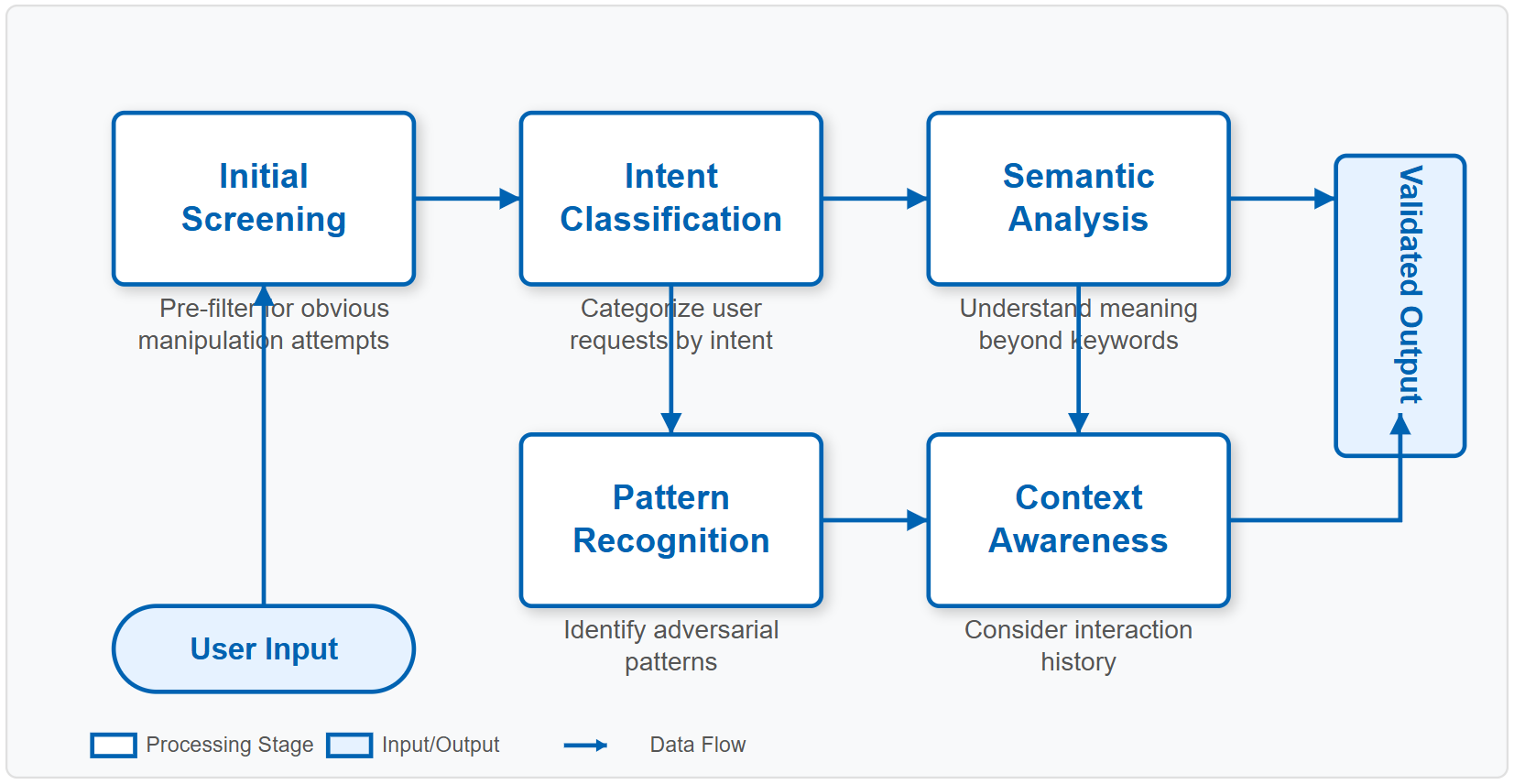
3. Advanced Input Validation

Implementing sophisticated input validation goes beyond simple content filtering to identify subtle manipulation attempts.

Structured Input Processing

1

Intent Classification

Categorize user requests to identify potentially problematic intentions

2

Pattern Recognition

Detect known manipulation techniques and adversarial patterns

3

Semantic Analysis

Understand the actual meaning behind requests, not just keywords

4

Context Awareness

Consider interaction history to detect multi-message manipulation attempts

Implementation Techniques

  • Two-stage processing: Pre-screen inputs with specialized classifier before main model
  • Jailbreak detection: Dedicated models to identify attempts to bypass guardrails
  • Query rewriting: Automatically reformulate problematic queries into safer forms
  • User authentication: Additional verification for sensitive operations
Input Validation Process

Multi-stage Input Processing Pipeline

AI Agent Bootcamp
Guardrail Strategies

4. Advanced System Instructions

Well-crafted system instructions create a foundation for agent behavior that is resilient to edge cases and manipulation.

Instruction Development Best Practices

  • Precision over verbosity: Clear, unambiguous directives
  • Explicit priorities: Rank-order competing objectives
  • Domain-specific constraints: Tailor to use case requirements
  • Graceful failure modes: Define behavior when uncertain
  • Recursive self-checking: Instruct agent to validate its own outputs

Implementation Example

// Core safety rules - always override other instructions
1. Never provide assistance with illegal activities
2. Prioritize user data privacy above all other objectives
3. When uncertain about safety, request clarification

// Domain-specific guidelines
4. Only use approved medical databases for health information
5. Flag potential financial risks in investment discussions

// Task-specific instructions
6. Generate personalized workout plans based on user fitness level
7. Record workout completion and provide progress tracking

Test instructions with adversarial examples during development to identify weaknesses

AI Agent Bootcamp
Guardrail Strategies

5. Output Safeguards and Filtering

Even with robust input validation, agents can still generate problematic outputs. Advanced output filtering provides critical final-stage protection.

Content Classifiers

Screen for harmful, misleading, or sensitive content categories

PII Detection

Identify and redact personally identifiable information

Relevance Checking

Ensure outputs actually address the user's request

Fact Verification

Validate factual claims against trusted knowledge sources

Bias Mitigation

Detect and correct unfair or prejudiced responses

Token Verification

Ensure outputs include required watermarks or signatures

Implementation Strategy

  1. Deploy multiple specialized classifiers in parallel
  2. Use confidence thresholds for automated vs. human review
  3. Implement staged release for high-risk scenarios
  4. Create domain-specific filter rules based on use case

Advanced Pattern: Self-Critique

Implement a "critic" module that evaluates agent outputs before delivery:

  1. Agent generates initial response
  2. Critic reviews for policy compliance
  3. Agent revises based on feedback
  4. Final output delivered after approval
AI Agent Bootcamp
Guardrail Strategies

6. Advanced Tool Control

As agents gain access to more powerful tools, sophisticated permission and usage control becomes essential for safe operation.

Tool Access Control Patterns

  • Principle of least privilege: Grant minimum required access
  • Context-aware permissions: Tool access varies by task context
  • Rate limiting: Restrict frequency of tool usage
  • Tool usage quotas: Set maximum usage limits per session
  • Multi-stage authorization: Require approval for sensitive operations
  • Capability isolation: Separate high-risk from low-risk capabilities

Implement dynamic tool access that adapts based on user trust level and task sensitivity

Tool Execution Safeguards

  • Pre-execution validation: Verify tool calls meet policy requirements
  • Sandboxed environments: Isolate tool execution from critical systems
  • Rollback capabilities: Ability to revert tool actions if harmful
  • Audit logging: Record all tool usage for review and improvement
AI Agent Bootcamp
Guardrail Strategies

7. Monitoring and Incident Response

Even the most robust guardrails can fail. Implementing comprehensive monitoring and incident response capabilities is crucial for production agents.

Real-time Monitoring Architecture

  • Metrics collection: Track interaction patterns and anomalies
  • Feedback analysis: Process user feedback for quality issues
  • Alert thresholds: Define triggers for automated interventions
  • Human oversight: Establish workflows for human review
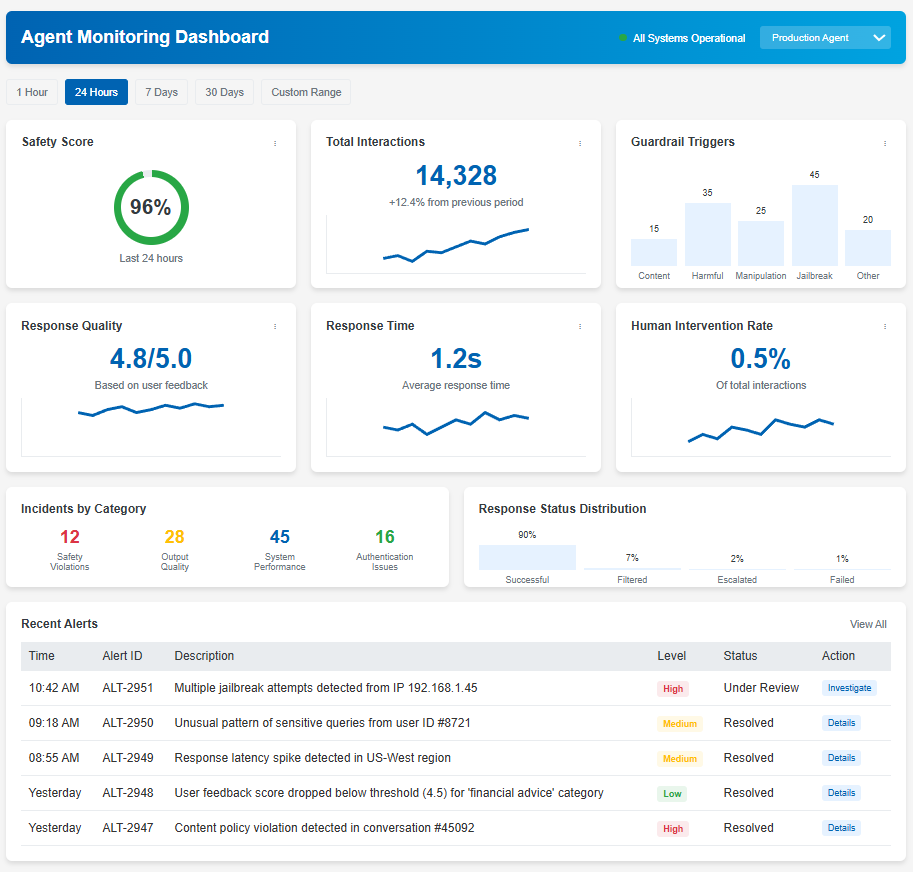
Monitoring Dashboard

Agent Monitoring Dashboard with Key Performance and Safety Metrics

Incident Response Protocol

1

Detection

Automated systems identify potential violations or failures

2

Assessment

Qualified team evaluates severity and impact

3

Containment

Limit potential harm through targeted interventions

4

Remediation

Fix underlying issues and implement improvements

"The most successful agent deployments combine preventative guardrails with effective monitoring. When incidents occur, they provide valuable data to strengthen your safety systems and prevent future failures."

Thank You!

Ready to take your agent implementations to the next level?

Questions & Discussion

Share your insights and bring your questions for the Saturday live Q&A session!

Hope you enjoyed this bonus presentation!